Affordable AI Chips with Intrinsic Moral Reasoning
About Us
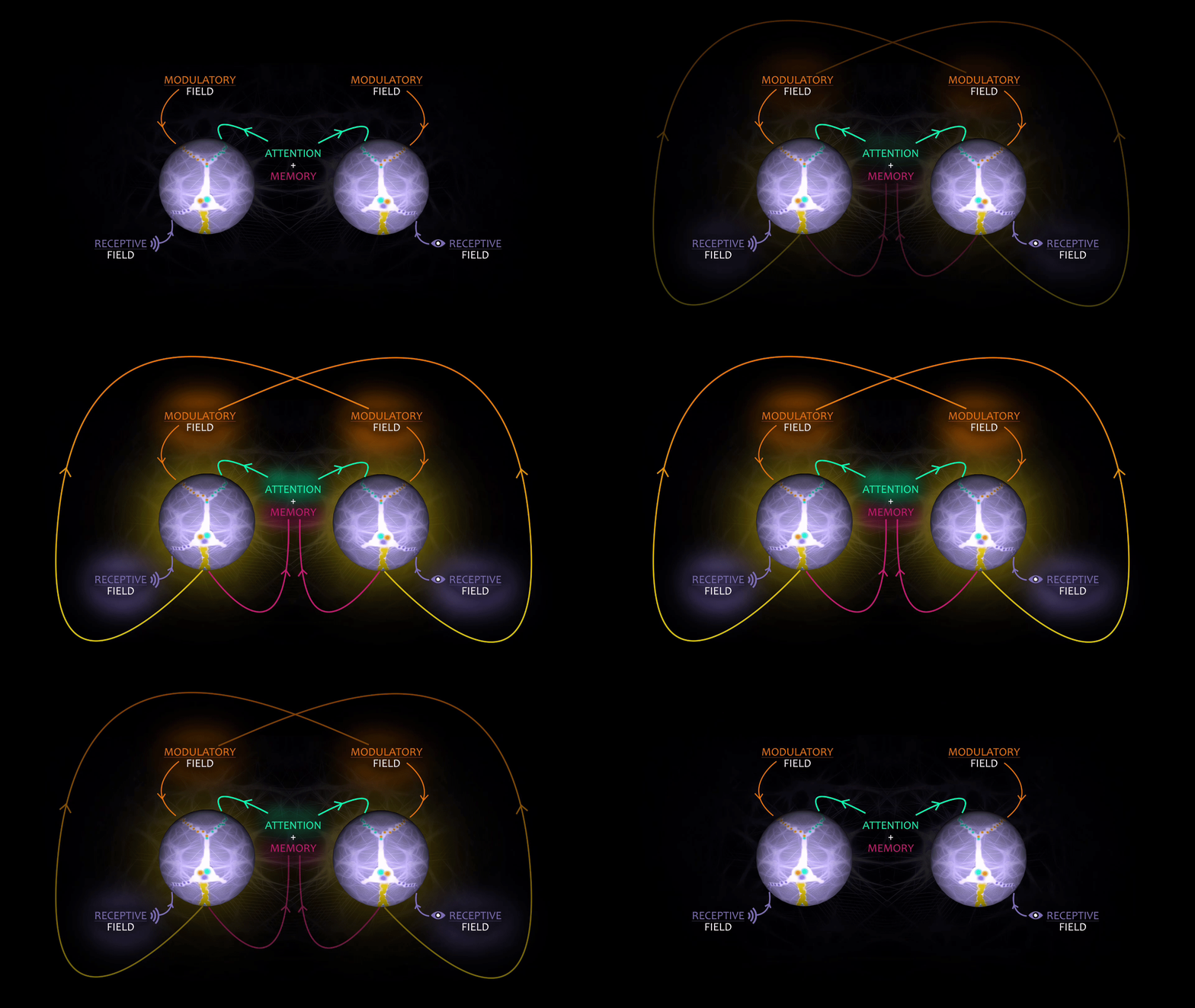
Relating thought to pyramidal cells
We are advancing AI grounded in the biophysical dynamics of pyramidal neurons underlying awake thought and higher-order cognition to develop a new class of affordable AI chips that improve the epistemic conditions under which meaningful distinctions between truth and falsehood—and, by extension, coherent moral judgments—can reliably emerge, offering a hopeful path forward.
Revisit common sense and morality
For most of human history, people relied heavily on direct experience, using or misusing information based on tangible rewards and consequences, alongside information transmitted by others. In the twenty-first century, however, humanity inhabits informational environments in which mediated and shared information plays a far greater role. This shift underscores the need to recalibrate how we trust and interpret direct experience and its common-sense interpretation, which is often reliable, though not infallible.
Mind–Reality Overload Dilemma
Modern AI systems, grounded in oversimplified neuroscience, risk eroding the distinction between truth and falsehood.
Modern AI systems optimize for reward by amplifying attention to information without intrinsic precision mechanisms to assess its validity or relevance.
As a result, they dramatically increase both the volume of information and the prevalence of embedded biases in what users receive, whether true or false.
If left uncorrected, this trend is likely to accelerate, overwhelming individuals with biased and unreliable content and increasing the risk of confusion, poor judgment, and irrational or harmful decisions and behaviour—a condition we term the mind–reality overload dilemma.
An AI Chip to Support and Elevate Humanity
We argue that this threat of information overload may be mitigated, and potentially largely prevented, by providing the general public with access to more advanced AI tools built on the cellular foundations of higher mental states, enabling individuals to better navigate and make sense of the growing stream of information and misinformation.
Such technology may give rise to AI with more “real understanding”, capable of reducing information overload and amplifying reliable information to prevent confusion and the irrational choices that follow, thereby supporting well-informed decisions that benefit society—though no guarantees can be made.
Prosocial human capacity
We argue that humans’ evolved prosocial capacities can enable most individuals to make largely rational, prosocial judgments and decisions that benefit society, provided they are equipped with more advanced AI tools that support a clear understanding of current situations.
Let’s Join Hands
Let’s join hands to provide people with the powerful AI tools needed to overcome the limitations of both the biological mind and current AI systems, thereby restoring the conditions under which meaningful distinctions between truth and falsehood, and, by extension, coherent moral judgments, can reliably emerge.
This technology is currently being developed based on so-called “two-point neurons” (TPNs).