Affordable AI Chips with Intrinsic Moral Reasoning
About Us
Relating thought to pyramidal cells
A new form of AI chip that is 1,000 times more economical, embodying aspects of common sense and moral reasoning while enhancing users’ capacity to make informed judgments.
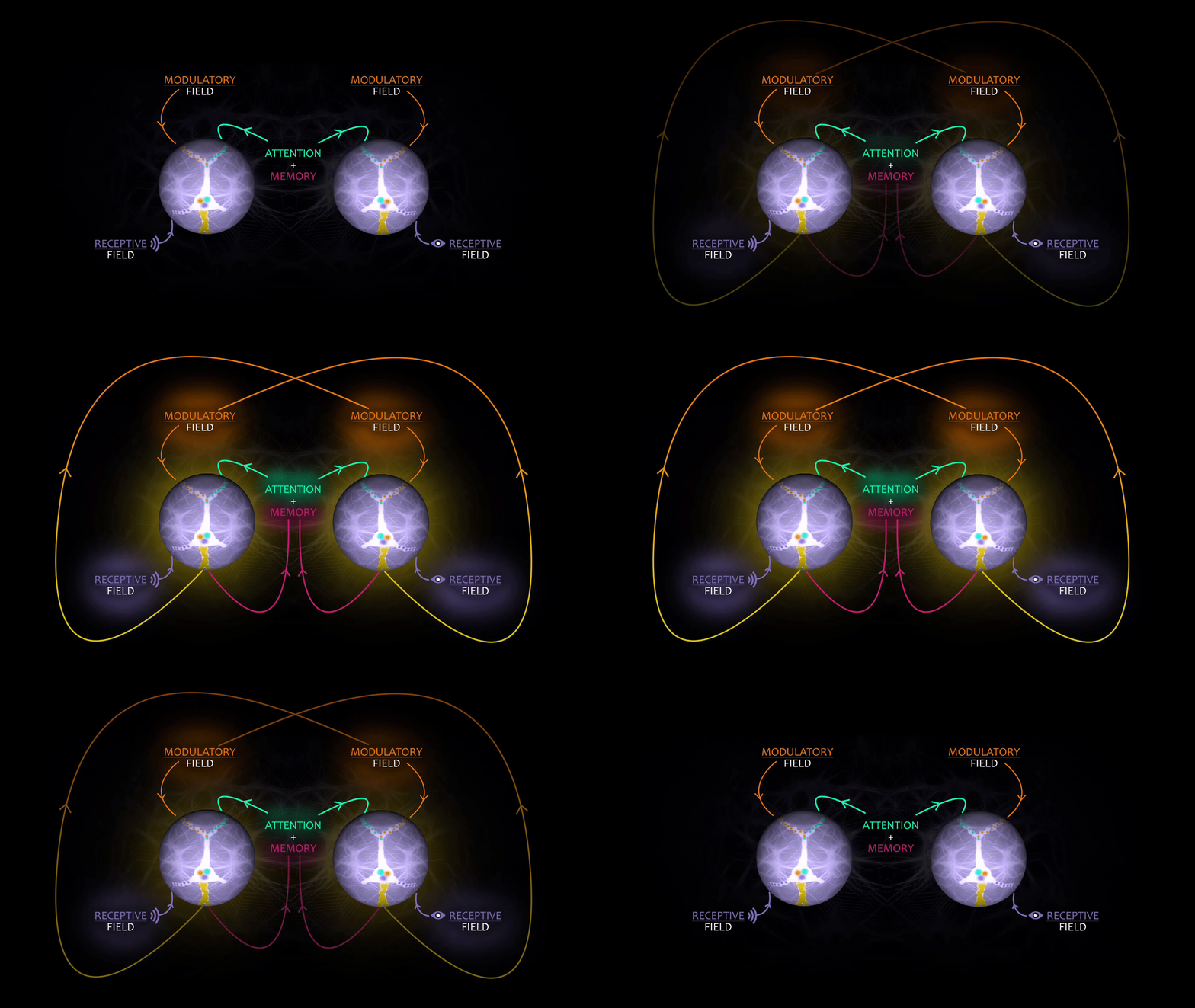
The Conscious Multisensory Integration (CMI) Lab at the University of Stirling is uncovering how neocortical pyramidal two-point cells operate across mental states, including deep sleep, wakefulness, and imaginative thinking, helping bridge the gap between brain and mind.
Early investigations suggest that these cellular mechanisms could be embodied in machines, enabling intrinsic efficiency as well as elements of common-sense and moral reasoning.
This is crucial, as increasingly powerful AI systems lacking robust epistemic mechanisms may produce unreliable or harmful outcomes.
Revisit common sense and morality
For most of human history, people relied heavily on direct experience, using or misusing information based on tangible rewards and consequences, alongside information transmitted by others. In the twenty-first century, however, humanity inhabits informational environments in which mediated and shared information plays a far greater role. This shift underscores the need to recalibrate how we trust and interpret direct experience and its common-sense interpretation, which is often reliable, though not infallible.
The evolution of misinformation
We have inadvertently created AI systems that can amplify misinformation, at times overshadowing common sense, imagination, and moral reasoning.
Recent developments in IT, including AI, the Internet, and social media, have massively increased both the volume of information users receive and its inherent biases. Current AI systems exacerbate this trend by optimizing reward and amplifying misinformation. If uncorrected, this trajectory is likely to accelerate, overloading individuals with biased and unreliable information and increasing the risk of confusion, poor judgment, and harmful decisions and behavior.
An AI chip to support and elevate humanity
We argue that this threat of information overload may be counteracted by providing the general public with more powerful AI tools that enable them to interpret the growing stream of information and misinformation, thereby reducing confusion and supporting more rational judgments and decisions.
Prosocial human capacity
We further argue that humans’ evolved prosocial capacities will lead most individuals to make largely rational, prosocial judgments and decisions that serve society, provided they are equipped with more powerful AI tools that enable a clear understanding of current situations.
A new type of brain-inspired AI technology
We aim to develop a new type of brain-inspired AI technology that supports the epistemic conditions under which coherent judgments and decisions serve society. Based on so-called “two-point neurons” (TPNs), this approach may give rise to AI with more “real” understanding.