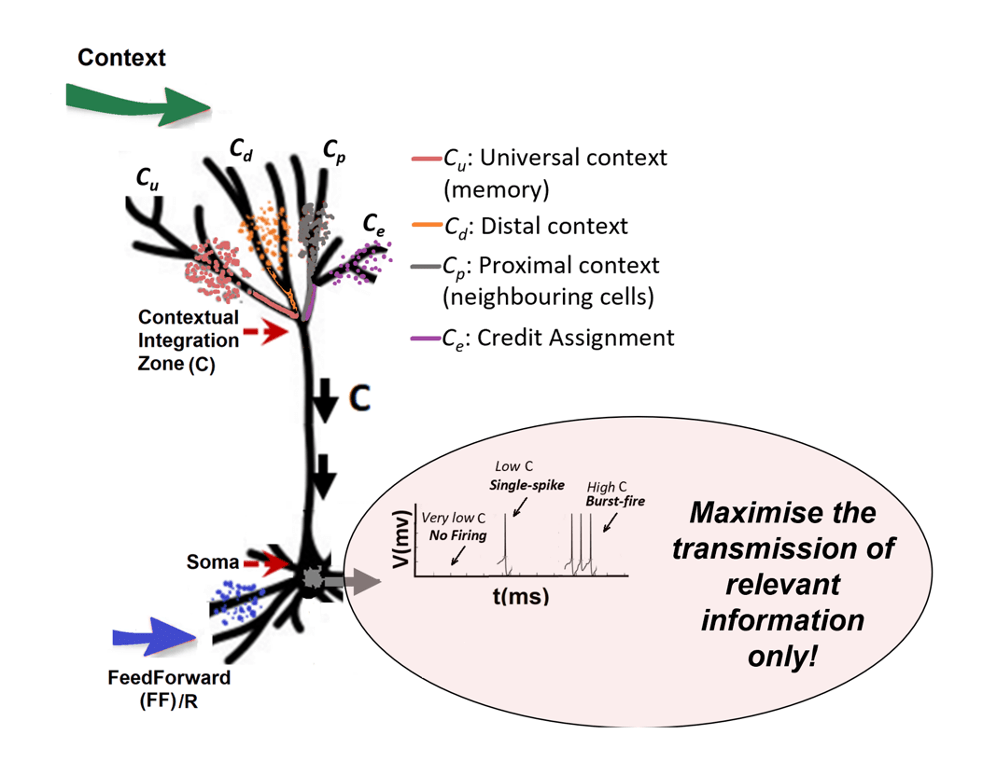
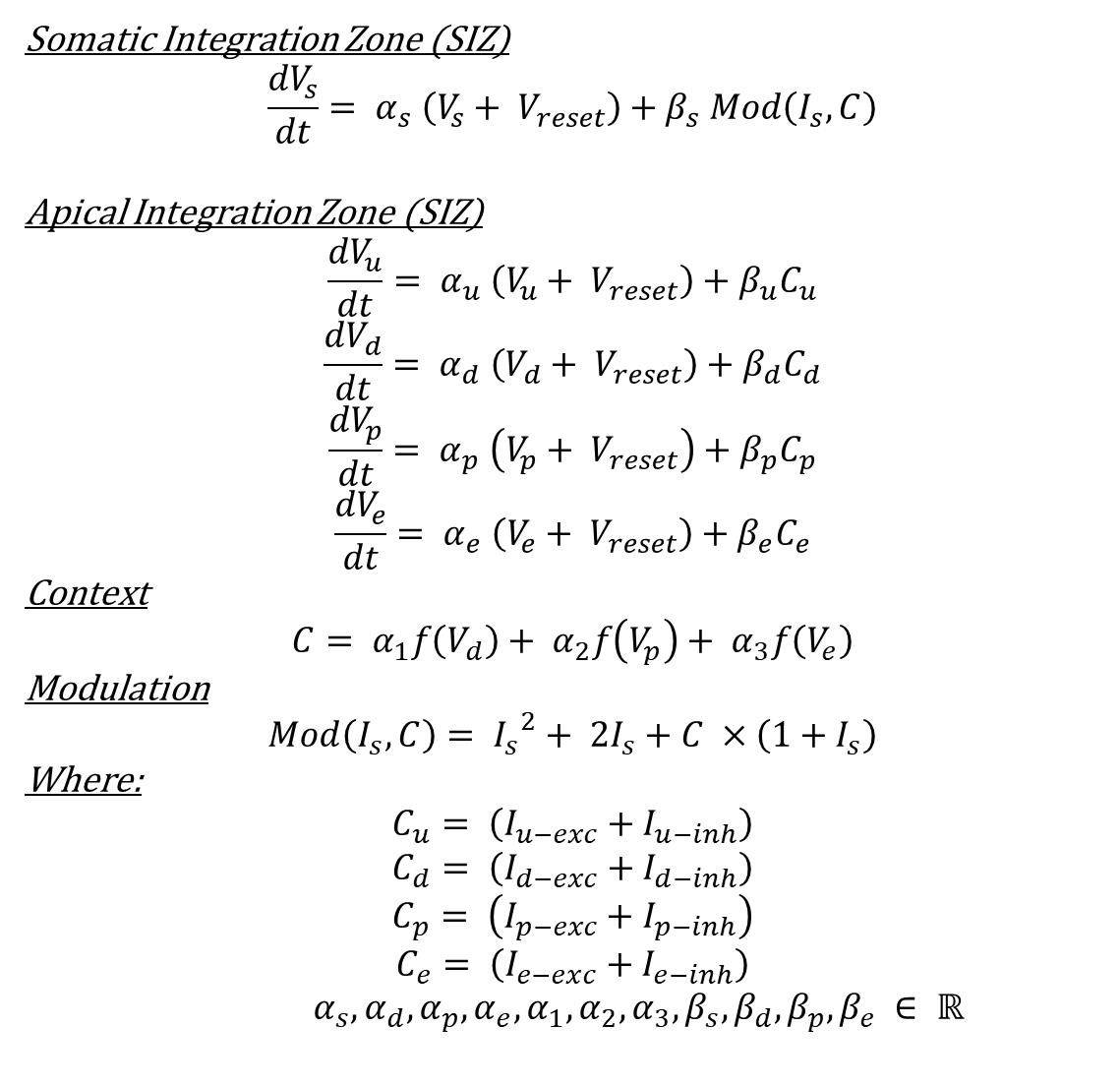
Going beyond standard backpropagation and building on burst-dependent synaptic plasticity (BDSP) (Payeur, Nature Neuroscience, 2021), we integrate our context-sensitive two-point neuron (CS-TPN) model into biologically plausible two-point neuron (TPN)-driven BDSP. In our model, the CS-TPN is divided into two integration zones: the Somatic Integration Zone (SIZ) and the Apical Integration Zone (AIZ).
At the AIZ, different contextual inputs, including, but not limited to, universal context (C_u), distal context (C_d), proximal context (C_p), and credit assignment (C_e), are represented as contextual voltages that evolve according to independent differential equations. The integrated context (C) is computed from these evolved contextual voltages and eventually affects the SIZ by modulating the receptive current: amplification when C is high and suppression when C is low.
In this scheme, information is encoded through neuronal firing (single spike = blue; burst of spikes = red). The CS-TPN differentiates between irrelevant, relevant, and highly relevant information, no spike, single spike, and burst of spikes, respectively, thereby improving learning efficiency. In the raster plots, CS-TPNs remain largely silent when information is less relevant and become active (bursting) otherwise. It can also be observed that TPNs fire more frequently than CS-TPNs.